Dear All (a wonkish guide to something you may have thought was obvious AND with thanks to Aaron Dane for co-authoring this newsletter),
In a position paper recently released in the New England Journal of Medicine, we have notice of a shift in FDA policy from a default expectation of two pivotal trials to a default of one pivotal trial + confirmatory evidence for approvals. Although two trials might still be needed for some approvals, the shift is in the starting default. To follow the plot, here are the links you need:
- [The new paper] Prasad V, Makary MA. One Pivotal Trial, the New Default Option for FDA Approval — Ending the Two-Trial Dogma. NEJM 2026;394(8):815–7. DOI: 10.1056/nejmsb2517623.
- [The serially updated one-trial guidance documents from FDA]
- “The 2023 Effectiveness Guidance”: Demonstrating Substantial Evidence of Effectiveness With One Adequate and Well-Controlled Clinical Investigation and Confirmatory Evidence. Available at https://www.fda.gov/regulatory-information/search-fda-guidance-documents/demonstrating-substantial-evidence-effectiveness-one-adequate-and-well-controlled-clinical.
- “The 2019 Effectiveness Guidance”: Demonstrating Substantial Evidence of Effectiveness for Human Drug and Biological Products (December 2019): https://www.fda.gov/media/133660/download.
- “The 1998 Effectiveness Guidance”: Providing Clinical Evidence of Effectiveness for Human Drug and Biological Products (May 1998): https://www.fda.gov/media/71655/download
- These 3 documents build on each other and are worth reading in their totality.
- [A review paper on use of single pivotal trials] Morant, A.V. and Vestergaard, H.T. European Marketing Authorizations Granted Based on a Single Pivotal Clinical Trial: The Rule or the Exception?. Clin Pharm Ther 104:169-177, 2018, doi: 10.1002/cpt.900.
- [A commentary on the new policy] 18 Nov 2026 Regulatory Focus, “Experts react to FDA’s shift to single pivotal trials for most drugs”.
- Quick summary of key critiques: How was this developed? Were other agencies consulted? What about safety?
- [A bit of math for context] When we use P < 0.05 as the threshold for success in a superiority study, the 5% threshold is used as a 2-tailed test. Thus, the chance that a completely inert compound would give a positive result by chance is 2.5% (half of 5%). If you do two independent trials, an inert compound would only give a positive result by chance in both trials at a rate of 2.5% x 2.5% = 0.06%.
- Requiring 2 independent trials has been detailed in guidance and is noted to offer both replication of results (showing reproducibility) and as well the low likelihood of two false positive results,
- On the other hand, the idea of accepting a single trial with confirmatory evidence infers that insight gained from other sources can provide a comparable degree of support for a single trial.
- [It’s a bit tangential but you might also want to review the recent FDA guidance on Bayesian methods and the use prior probability to support inference of clinical effectiveness] Food and Drug Administration 2026. Use of Bayesian Methodology in Clinical Trials of Drug and Biological Products. Available at https://www.fda.gov/regulatory-information/search-fda-guidance-documents/use-bayesian-methodology-clinical-trials-drug-and-biological-products
With that as background, let’s take a Q&A approach to analyzing this new position paper.
Question #1: Isn’t ‘one trial in one indication’ something we routinely do with new anti-infectives? Well, the big deal is that we have NOT always taken this approach! Yes, it is reasonably common in oncology settings and for orphan diseases (see below) but Aaron and I can recall receiving very clear regulatory guidance as late as ~2010-11 that a new antibacterial would need two identical trials for each indication sought — and it wasn’t even possible to reduce this by doing single trials in each of two related indications! It was then rather a big deal a few years later when arguments were made (and accepted) that a single trial of a new antimicrobial in a single form of infection could really be enough for initial approval.
Question #2: What changed to allow a single trial to be enough? The key concept underpinning the use of a single pivotal trial is the idea of confirmatory evidence. As the paper by Prasad and Makary says, “in the modern world, as drug discovery becomes increasingly precise and scientific, the FDA considers not just effects on survival, but biochemical and intermediate changes that tell a complete biologic story: does this drug actually work?”
Importantly, this is not a new idea at all! FDA laid out this idea in a 1998 paper (with the 2019 and then 2023 updates cited above) when the argument was made that a single pivotal trial could be enough if supported by confirmatory evidence (and we’ll see below that EMA made similar arguments in 2001). Per FDA, there are 7 broad categories of confirmatory evidence:
- Clinical evidence from a related indication
- Mechanistic or pharmacodynamic evidence
- Evidence from a related animal model
- Evidence from other members of the same pharmacological class
- Natural history evidence
- Real-world data/evidence
- Evidence from expanded access use of an investigational drug
Examples of the strengths and weaknesses of these approaches are all given in the one-adequate-trial guidance document. Anti-infectives appear as the poster child in the category of “Evidence from a related animal model”:
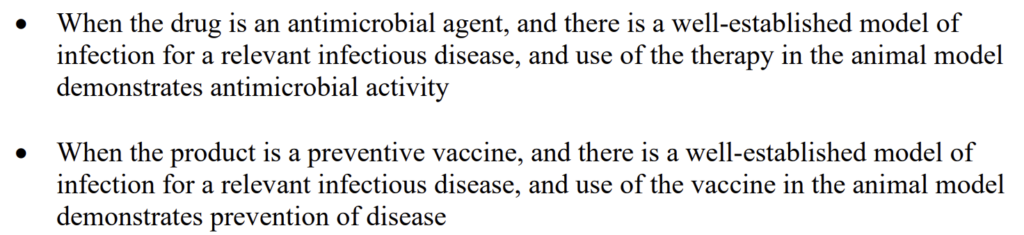
Yes, that’s the idea of anti-infectives in a nutshell — the ability to generate extensive non-clinical data is very powerful with anti-infectives: We know why it works, we know how much is needed for it to work, and we would be surprised if it did not work. You still need clinical data for both safety and efficacy, but one good demonstration of efficacy can be enough for anti-infectives precisely because the supportive evidence is available. There are no guarantees that this will always lead to success, but it has been an important prerequisite (see also Question 4, below).
Question #3: Are single trials used as the basis of approval in other therapy areas? Yes, absolutely. In particular, rare (orphan) diseases and cancer have often had to rely on the idea of single trials due to the relative rarity of the patients. And although the pre-clinical to clinical translation is not always as strong in disease areas other than anti-infectives, the FDA’s recent “Plausible Mechanism” guidance https://www.fda.gov/regulatory-information/search-fda-guidance-documents/considerations-use-plausible-mechanism-framework-develop-individualized-therapies-target-specific is clearly aligned with the idea of a single pivotal trial as the basis for approval.
Question #4: How reliable is the supportive evidence for anti-infectives? Does it ever fail? The evidence from good animal models and such is indeed very strong but it is important to be alert as there are occasional surprises. As well one well-known example, it was a surprise when daptomycin (very clearly active in skin infections) did not work in pneumonia due to local inactivation by surfactant. For more examples of surprises, see Cox, Nambiar, and Baden: “Needed: Antimicrobial development” NEJM, 2019, DOI: 10.1056/nejme1901525.
Question #5: So, Prasad and Makary are arguing that 1 trial should be the general default! Why? Digging a bit deeper, Prasad and Makary lay out a good review of the background on the core argument behind two trials: most notably, requiring two positive trials reduces the chance that an inactive compound can reach approval from 2.5% to 0.06%. But, they then argue cogently that modern developers use both statistical and biologic data to support demonstrations of efficacy with the biologic data encompassing knowledge of mechanism of action, effects on biomarkers, and intermediate endpoints all contributing to confidence about clinical credibility.
- Note that the new paradigm assumes that in most cases the confirmatory evidence will be sufficiently strong enough that the false positive risk is reduced sufficiently from 2.5% (the false-positive risk for one trial) to be convincing. While we think this is true for anti-infectives it’s not yet clear how this will be assessed for other therapy areas.
- Although not mentioned specifically, some of their text also aligns with the use of the Bayesian concepts of prior probability (as cited at the start of this newsletter, see the FDA’s recent guidance on this).
Question #6: Does EMA accept the idea of single trials as the basis of approval? Like FDA, EMA laid out the idea of a 1-trial approach in a 2001 document entitled “Draft points to consider on validity and interpretation of meta-analyses, and one pivotal study” (https://www.ema.europa.eu/en/application-1-meta-analyses-2-one-pivotal-study-scientific-guideline). But it is important to appreciate their cautious approach to the idea … here’s the key text … read the last two lines closely:

The accompanying text expands on the idea of “particularly compelling” by stating “Statistical evidence considerably stronger than p<0.05 is usually required, accompanied by precise estimates of treatment effects, i.e. narrow confidence intervals.” So, if P < 0.05 is not enough (that’s the P value with 2.5% risk of a false-positive), then in effect you may end up needing that one trial to have a size that approaches that of two trials. See also the comment in Q5 (above) about adjusting routine assumptions regarding the strength of the confirmatory evidence.
That noted, it is of course evident, that EMA (and other agencies) have approved many agents based on a single trial and thus demonstrated concurrence with the themes proposed by Prasad and Makary. The most obvious example is in anti-infectives where single pivotal trials have been accepted since the early 20-teens. The 2018 paper by Morant and Vestergaard expands this to non-orphan, non-oncology therapy areas (orphan and oncology have often used single trials for reasons particular to those areas) when it notes that 23 novel therapeutics were approved during 2012-2016 by EMA and/or FDA for 27 non-orphan, non-oncology indications based on a single pivotal trial. But, the authors point out that the single pivotal trials tended to have strong statistics (i.e., P values well separated from 0.05) and there was consistently good supportive evidence (often from other clinical trials).
Question #7: If one trial has been OK since 1998 [FDA] and 2001 [EMA], why do we need this new position paper? Prasad and Makary note that the idea of a default expectation is important as default expectations anchor thinking in ways that can be hard to overcome. In support, the authors cite the seminal work of the economist and Nobel laureate Daniel Kahneman on the rational and non-rational biases that color our decision-making processes. If you’ve not read his Thinking Fast, Thinking Slow, please do so soon … you will be startled to learn the extent to which the last thing you heard (or the time of day or even the last color you thought about) can influence what you believe to be an entirely rational decision.
Question 8: Wow … that’s a lot to digest! Is this idea going to actually stick? Are the confirmatory data really routinely sufficient to support this position for all therapy areas? As discussed in the news analysis article cited above, it is unfortunate that the position paper doesn’t provide insight into how the new position was developed and whether other stakeholders (other agencies, patient interest groups, etc.) will concur with the strategy. So, it could well be that the prudent path for a developer will be to continue to treat the single trial approach as the exception rather than the rule.
—
In summary, it is interesting to see how thinking might shift over time. Based on the strength of the supportive evidence that can be generated routinely, anti-infectives were just a bit ahead of the game in terms of setting a default expectation of a single trial. It’s very interesting to see a proposal to make single trials the general default but we suspect that more conversation is going to be needed before this truly becomes normative.
All best wishes, John & Aaron
John H. Rex, MD | Chief Medical Officer, F2G Ltd. | Operating Partner, Advent Life Sciences. Follow me on Twitter: @JohnRex_NewAbx. See past newsletters and subscribe for the future: https://amr.solutions/blog/. All opinions are my own.
Aaron Dane, CStat | DaneStat Consulting Limited | aarondane@danestat.com | www.linkedin.com/in/aaronldane | All opinions are my own.
John’s Top Recurring Meetings
Virtual meetings are easy to attend, but regular attendance at annual in-person events is the key to building your network and gaining deeper insight. My personal favorites for such in-person meetings are below. Of particular value for developers, the small meeting format of BEAM’s AMR Conference (March) and GAMRIC (September-October; formerly, the ESCMID-ASM conference series) creates excellent global networking. IDWeek (October) and ECCMID (April) are much larger meetings but also provide opportunities for networking with a substantial, focused audience via their Pipeline sessions. Hope to see you there!
- 17-21 April 2026 (Munich, Germany): ESCMID Global 2026, the annual meeting of the European Society for Clinical Microbiology and Infectious Diseases. You can go here to register and view the preliminary program; the abstract submission window for 2026 will run 15 October to 26 Nov 2025. For those who would like a substantial opportunity to present a product to a large audience (see also adjacent note about IDWeek), I know that the meeting schedule will again include Pipeline Monday.
- [REGISTRATION IS NOW OPEN!] 22-24 Sep 2026 (Lisbon, Portugal): The 2nd GAMRIC, the Global AMR Innovators Conference (London, UK). Formerly the ESCMID-ASM (or ASM-ESCMID depending on location) Joint Conference on Drug Development for AMR, 2026 will be the 11th year for this series that is now under the joint sponsorship of CARB-X, ESCMID, BEAM Alliance, GARDP, LifeArc, Boston University, and AMR.Solutions. The ongoing series employs the successful format of prior meetings with a single-track meeting and substantial networking time. The 2025 meeting was a sell-out success! A written summary of the meeting is here and the video from the sessions is now available here. Registration opens 1 March 2026; the abstract submission window will be 10-31 March 2026 with a late-breaker window in July.
- 21-24 Oct 2026 (Washington, DC, USA): IDWeek 2026, the annual meeting of the Infectious Diseases Society of America. Details are not yet available but I would expect the program to continue to provide a substantial opportunity to present a product to a large audience (see also adjacent note about ESCMID) as well as opportunities to present at an IDWeek Pipeline Session.
- [Dates announced for 2027] 23-24 Mar 2027 (Basel, Switzerland): The 10th AMR Conference (3-4 Mar 2026) is now over and offered a rich program that included a 10-year retrospective (we’ve done a lot!), regulatory updates, discussions of how to pursue development in China, and much more … in addition to being a superb opportunity for networking! I am told the session videos will soon be available on the conference website. Mark your calendars for next year!
Upcoming meetings of interest to the AMR community:
- 8-13 Mar 2026 (Renaissance Tuscany Il Ciocco, Italy): 2026 Gordon Research Conference (GRC) entitled “Antibacterials of Tomorrow to Combat the Global Threat of Antimicrobial Resistance.” A Gordon Research Seminar (GRS) will be held the weekend before (7-8 Mar) for young doctoral and post-doctoral researchers. Space for the GRS and the GRC is limited; for details and to apply, go here for the GRC and here for the GRS.
- [NEW] 13 Mar 2026 (12.00-13.30 ET, virtual): REVIVE (GARDP)-sponsored webinar: “Current developments in Clostridioides difficile prevention, therapy and R&D.” Go here for details and to register.
- [NEW] 24 Mar 2026 (1-2p ET, virtual): CDC webinar entitled “Tools to Tell the Story: New Resources for Communicating about Antimicrobial Resistance.” Go here for additional details to register,
- [NEW] 26 Mar 2026 (12.00-13.30 ET, virtual): REVIVE (GARDP)-sponsored webinar: “Journal Club: Key findings from recent publications in antimicrobial R&D.” Go here for details and to register.
- 17-21 April 2026 (Munich, Germany): ESCMID Global 2026, the annual meeting of the European Society for Clinical Microbiology and Infectious Diseases. See Recurring Meetings list, above.
- 4-8 June 2026 (Washington, DC): ASM Microbe, the annual meeting of the American Society for Microbiology. The meeting format is evolving and next year will combine 3 meetings (ASM Health, ASM Applied and Environmental Microbiology, and ASM Mechanism Discovery) into one event. Go here for details.
- [NEW] 11-12 Jun 2026 (Washington, DC): The Second Annual Unite for Sepsis Symposium, presented by the Sepsis Alliance. The event seeks to accelerate progress in sepsis research and care. Go here for details and to register.
- 22-24 Sep 2026 GAMRIC (Lisbon, Portugal), the Global AMR Innovators Conference (London, UK; formerly the ESCMID-ASM Joint Conference on Drug Development for AMR). See list of Top Recurring meetings, above..
- [REGISTRATION DATES ANNOUNCED] 10-18 Oct 2026 (Annecy, France, residential in-person program): ICARe (Interdisciplinary Course on Antibiotics and Resistance) … and 2026 will be the 10th year for this program. Patrice Courvalin orchestrates content with the support of an all-star scientific committee and faculty. The resulting soup-to-nuts training covers all aspects of antimicrobials, is very intense, and routinely gets rave reviews! Registration for 2026 will be during March 16–July 3, 2026. You can go here for more details and you should put a reminder in your calendar register on / after 16 March.
- 21-24 Oct 2026 (Washington, DC, USA): IDWeek 2026. See list of Top Recurring meetings, above.
- 10-13 November 2026 (Madrid, Spain): The International Society for Infectious Diseases (ISID) has announced its 21st International Congress on Infectious Diseases (ICID). Register and view the preliminary program here (Early bird closes 30 July 2026); abstract deadline is 28 April 2026.
- 23-24 Mar 2027 (Basel, Switzerland): The 11th AMR Conference sponsored by the BEAM Alliance. See list of Top Recurring meetings, above.
Self-paced courses, online training materials, and other reference materials:
- OpenWHO: “Antimicrobial Resistance in the environment: key concepts and interventions.” Per the webpage for the course, it will teach you “…why addressing AMR in the environment is essential and gain insights into how action can be taken to prevent and control AMR in the environment at the national level.” This course builds on WHO’s 2024 Guidance on wastewater and solid waste management for manufacturing of antibiotics. For further reading, see also the 25 Sep 2023 newsletter entitled “Manufacturing underpins both access and stewardship: Cefiderocol as a case study” and the 28 Jan 2024 newsletter entitled “EMA Concept Paper: Guidance on manufacturing of phage products”.
- GARDP’s REVIVE website provides an encyclopedia covering a range of R&D terms, recordings of prior GARDP webinars, a variety of viewpoint articles, and more! Check it out!
- GARDP’s https://antibioticdb.com/ is an open-access database of antibacterial agents.
- The CARB-X website provides a range of recordings from its webinars, bootcamps, and more. A bit of browsing would be time well spent!
- British Society for Antimicrobial Chemotherapy offers an eLearning section: Education – The British Society for Antimicrobial Chemotherapy.
- The Horizon Europe Work Programme 2026-2027 includes at least 3 calls of interest within its Cluster 1 — see the list below. The application window starts 10 Feb 2026 and closes on 16 Apr 2026. See also the 12 Dec 2025 newsletter about the call. Note as well that there calls for agents to prevent and/or treat viral infections.
- HORIZON-HLTH-2027-01-DISEASE-08: Development of innovative antimicrobials against pathogens resistant to antimicrobials
- HORIZON-HLTH-2027-02-IND-02: Portable point-of-care diagnostics
- HORIZON-HLTH-2026-01-DISEASE-03:Advancing research on the prevention, diagnosis, and management of post-infection long-term conditions.
- ENABLE-2 has continuously open calls for both its Hit-to-Lead program as well as its Hit Identification/Validation incubator. Applicants must be academics and non-profits in Europe due to restrictions from the funders. Applications are evaluated in cycles … see the website for details on current timing for reviews.
- BARDA’s long-running BAA (Broad Agency Announcement) for medical countermeasures (MCMs) for chemical, biological, radiological, and nuclear (CBRN) threats, pandemic influenza, and emerging infectious diseases is now BAA-23-100-SOL-00004 and offers support for both antibacterial and antifungal agents (as well as antivirals, antitoxins, diagnostics, and more). Note especially these Areas of Interest: Area 3.1 (MDR Bacteria and Biothreat Pathogens), Area 3.2 (MDR Fungal Infections), and Area 7.2 (Antibiotic Resistance Diagnostics for Priority Bacterial Pathogens). Although prior BAAs used a rolling cycle of 4 deadlines/year, the updated BAA released 26 Sep 2023 has a 5-year application period that ends 25 Sep 2028 and is open to applicants regardless of location: BARDA seeks the best science from anywhere in the world! See also this newsletter for further comments on the BAA and its areas of interest.
- HERA Invest was launched August 2023 with €100 million to support innovative EU-based SMEs in the early and late phases of clinical trials. Part of the InvestEU program supporting sustainable investment, innovation, and job creation in Europe, HERA Invest is open for application to companies developing medical countermeasures that address one of the following cross-border health threats: (i) Pathogens with pandemic or epidemic potential, (ii) Chemical, biological, radiological and nuclear (CBRN) threats originating from accidental or deliberate release, and (iii) Antimicrobial resistance (AMR). Non-dilutive venture loans covering up to 50% of investment costs are available. A closing date is not posted insofar as I can see — applications are accepted on a rolling basis; go here for more details.
- The AMR Action Fund is open on an ongoing basis to proposals for funding of Phase 2 / Phase 3 antibacterial therapeutics. Per its charter, the fund prioritizes investment in treatments that address a pathogen prioritized by the WHO, the CDC and/or other public health entities that: (i) are novel (e.g., absence of known cross-resistance, novel targets, new chemical classes, or new mechanisms of action); and/or (ii) have significant differentiated clinical utility (e.g., differentiated innovation that provides clinical value versus standard of care to prescribers and patients, such as safety/tolerability, oral formulation, different spectrum of activity); and (iii) reduce patient mortality. It is also expected that such agents would have the potential to strongly address the likely requirements for delinked Pull incentives such as the UK (NHS England) subscription pilot and the PASTEUR Act in the US. Submit queries to contact@amractionfund.com.
- INCATE (Incubator for Antibacterial Therapies in Europe) is an early-stage funding vehicle supporting innovation vs. drug-resistant bacterial infections. The fund provides advice, community, and non-dilutive funding (€10k in Stage I and up to €250k in Stage II) to support early-stage ventures in creating the evidence and building the team needed to get next-level funding. Details and contacts on their website (https://www.incate.net/).
- CARB-X will have calls during April 2026 and 4Q 2026. The team have announced that at least one of the themes of both calls will be novel chemistry scaffolds.
- These things aren’t sources of funds but would help you develop funding applications
- The Global AMR R&D Hub’s dynamic dashboard (link) summarizes the global clinical development pipeline, incentives for AMR R&D, and investors/investments in AMR R&D. See also the 7 Feb 2026 newsletter (“The global funding pipeline, 2017-2023: A review”) about an excellent deep dive by the Hub team into patterns of funding over time.
- Antimicrobial Resistance Research and Innovation in Australia is an actively updated summary that covers Australia’s AMR research and patent landscape. It is provided via collaboration between The Lens (an ambitious project seeking to discover, analyse, and map global innovation knowledge) and CSIRO (Commonwealth Scientific and Industrial Research Organisation, an Australian Government agency responsible for scientific research). Lots to explore here!
- Diagnostic developers would find valuable guidance in this 6-part series on in vitro diagnostic (IVD) development. Sponsored by CARB-X, C-CAMP, and FIND, it pulls together real-life insights into a succinct set of tutorials.
- In addition to the lists provided by the Global AMR R&D Hub, you might also be interested in my most current lists of R&D incentives (link) and priority pathogens (link).