Dear All:
Significantly strengthening our database documenting the human cost of AMR, we now have an impressive survey of mortality associated with severe infections in 19 Asian countries during the period Sep 2022 to Feb 2025. Here are the links you need:
- (the primary paper): Mo Y, Hao X, Ding Y et al. Severe health-care-associated infections and antimicrobial resistance in an Asian Surveillance Network (ACORN-HAI): A multicentre, prospective cohort study. The Lancet Infectious Diseases, 2026; doi: 10.1016/S1473-3099(26)00357-9.
- (editorial about the paper): Mathers AJ and Munita JM: From estimates to evidence: measuring the true burden of AMR. The Lancet Infectious Diseases, 2026; doi: 10.1016/S1473-3099(26)00417-2.
- Background papers giving related estimates
- 20 Jan 2022 newsletter: “#AMRSOS! GRAM report: “at least 1.27m deaths/year directly attributable to AMR”
- 29 Apr 2024 newsletter: “R&D Implications: Global Burden of Disease is 28% Infectious!”
- 17 Sep 2024 newsletter: “#AMRSOS! AMR could worsen, killing 39m during 2025-2050”
In brief, Mo Yin & colleagues from the ADVANCE-ID network have assembled a research network spanning 19 countries in Asia and used it to obtain data on 28-day all-cause mortality (ACM) of infections requiring intravenous antimicrobial therapy:.
- Data were collected for 10,111 patients of whom 9,496 were included in the final analysis
- The investigators collected data on patient characteristics, the microbiology of the causative organism, and quality of life.
There’s a lot of good detail here that I am going to reduce to two figures focusing on 28-day ACM.
First up is this figure looking at crude 28-day ACM for VAP (ventilator-associated pneumonia), Hospital-acquired bloodstream infection (BSI), and Healthcare-associated BSI:
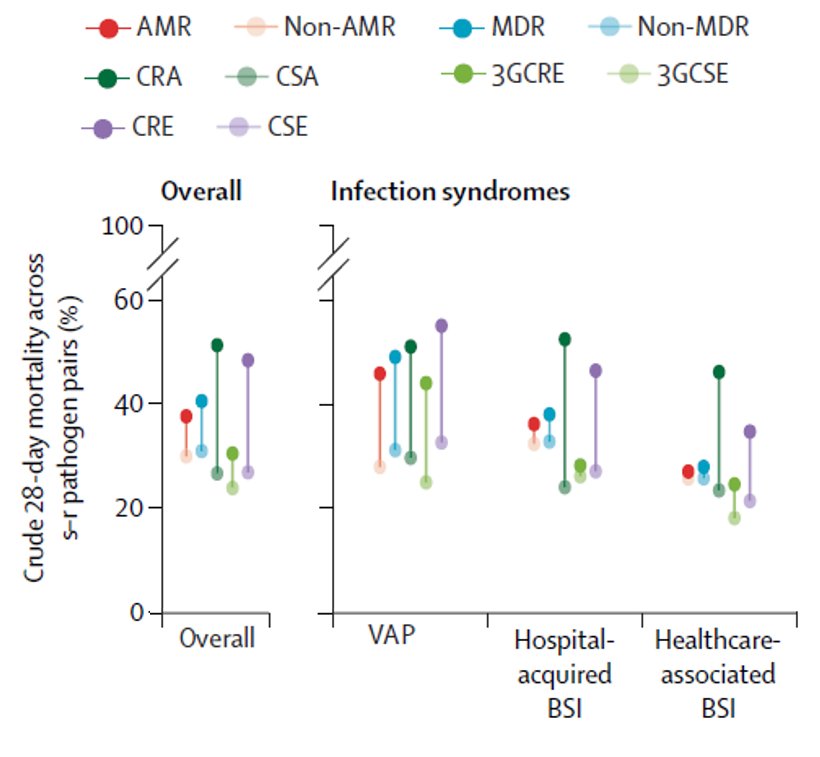
This one takes a bit of decoding. The core idea is that attributable mortality will be estimated as the difference between the ACM for susceptible and resistant pathogens. Here’s how to read the figure:
- Start by observing that there are 4 sub-panels in the figure, each containing 5 pairs of vertically connected dots
- Start with the first sub-panel for Overall and consider the first pair of light-red connected dots. Here we have the overall crude 28-day ACM from the entire cohort for infections due to a pathogen found resistant to at least one important drug (AMR, upper dot) vs. not meeting that test (non-AMR) … and the incremental ACM difference is just under 10%.
- The next pair in blue is for infections due to a pathogen found resistant to at least three important drugs (MDR, upper dot) vs. not meeting that test (non-MDR). Again, a difference of ~10%.
- In green, CRA/CSA is the pair for Carbapenem-resistant (or -susceptible) Acinetobacter spp. — and here we have a bigger difference — visually, about 25%
- In a lighter green, 3GCRE/3GCSE is the pair for 3rd-generation cephalosporin resistant/susceptible Enterobacterales — a difference of just a few %
- Finally (and in purple), CRE/CSE is the pair for carbapenem resistant/susceptible Enterobacterales with a difference of ~20%.
So, the concept here is that resistance would seem likely to drive higher mortality … and it did, in a pattern that is broadly similar when broken down by infection category. While just comparing susceptibility could easily miss other factors driving ACM (as discussed both in the paper and the editorial), the broad implications are nonetheless clear:
- ACM for these types of infections is high even with the susceptible pathogens
- And, resistance adds another 5-20% to the observed ACM
And as one demonstration that other factors are at play, this figure looks at the same concepts by socioeconomic status:
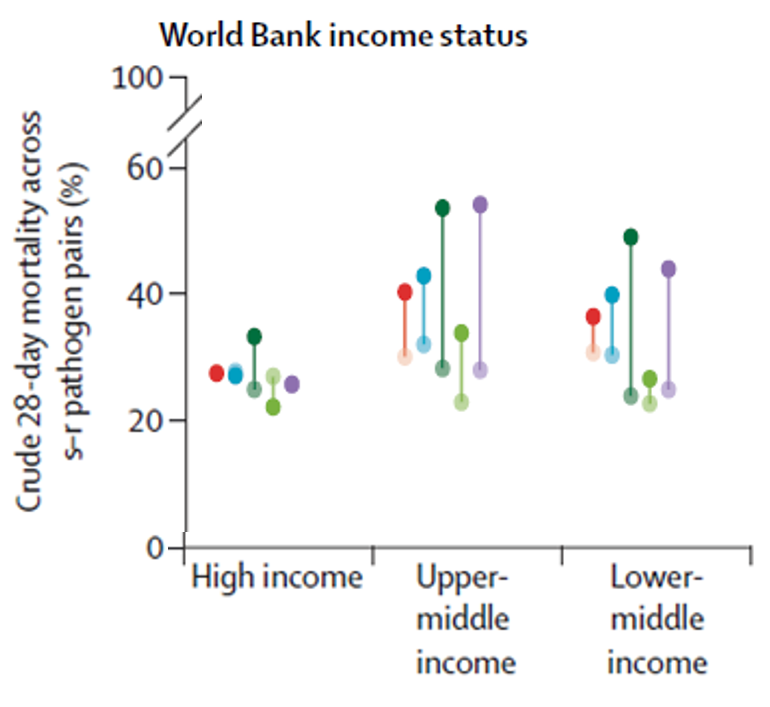
Thus, wealth gives a bit of an advantage but not an absolute one: ACM is still > 20%.
Also discussed in the text is the very interesting idea that functional status is generally poor after one of these infections. The authors used the 8-level Functional Bloodstream Infection Score (0 = dead, 7 = basically healthy) and the EQ-5D-3L health index score (0 = dead, 1 = perfect health, and values < 0 mean states worse than death). Of the patients remaining alive (about 50% of the whole population), there was not much difference for susceptible vs. resistant pathogens but full functional recovery (FBIS) was seen in < 30% and EQ-5D-3L scores were generally < 0.5).
And finally, the authors have converted their estimates from the study cohort into population-level estimates. With this, they find rates of AMR-attributable infections that are approximately double the rates in the landmark Murray study (#amrsos, see cites at the top of the newsletter). #AMRSOS, indeed!
—
This is an impressive piece of work and the team at ADVANCE-ID is to be thanked for their efforts! Yes, there are valid concerns about generalizability (well covered in the manuscript), but the raw rates do suggest a substantial and likely underestimated burden of AMR in Asia. We need to continue to advance work to create new therapies and (equally important) to make them available!
All best wishes, –jr
John H. Rex, MD | Chief Medical Officer, F2G Ltd. | Operating Partner, Advent Life Sciences. Follow me on Twitter: @JohnRex_NewAbx. See past newsletters and subscribe for the future: https://amr.solutions/blog/. All opinions are my own.
John’s Top Recurring Meetings
Virtual meetings are easy to attend, but regular attendance at annual in-person events is the key to building your network and gaining deeper insight. My personal favorites for such in-person meetings are below. Of particular value for developers, the small meeting format of BEAM’s AMR Conference (March) and GAMRIC (September-October; formerly, the ESCMID-ASM conference series) creates excellent global networking. IDWeek (October) and ECCMID (April) are much larger meetings but also provide opportunities for networking with a substantial, focused audience via their Pipeline sessions. Hope to see you there!
- [Don’t miss it!] 22-24 Sep 2026 (Lisbon, Portugal): The 2nd GAMRIC, the Global AMR Innovators Conference (London, UK). Formerly the ESCMID-ASM (or ASM-ESCMID depending on location) Joint Conference on Drug Development for AMR, 2026 will be the 11th year for this series that is now under the joint sponsorship of CARB-X, ESCMID, BEAM Alliance, GARDP, LifeArc, Boston University, and AMR.Solutions. The ongoing series employs the successful format of prior meetings with a single-track meeting and substantial networking time. The 2025 meeting was a sell-out success: a written summary is here and the videos are here. Registration for the 2026 meeting is now open and the near-final program is here: in addition to a keynote lecture by Karen Bush on the threat to beta-lactams due to the emergence of PBP3 mutations, there are sessions on funding, access, program design for narrow-spectrum agents such as phage, development for pediatrics, and more. Registration is ongoing.
- 21-24 Oct 2026 (Washington, DC, USA): IDWeek 2026, the annual meeting of the Infectious Diseases Society of America. I would expect the program to continue to provide a substantial opportunity to present a product to a large audience (see also adjacent note about ESCMID) as well as opportunities to present at an IDWeek Pipeline Session. Go here to register.
- 23-24 Mar 2027 (Basel, Switzerland): The 10th AMR Conference (3-4 Mar 2026) is now over and offered a rich program that included a 10-year retrospective (we’ve done a lot!), regulatory updates, discussions of how to pursue development in China, and much more … in addition to being a superb opportunity for networking! I am told the session videos will soon be available on the conference website.
- 9-13 April 2027 (Stockholm, Sweden): ESCMID Global 2027, the annual meeting of the European Society for Clinical Microbiology and Infectious Diseases. Details won’t be out for some months, but the website is here. I do know that the meeting schedule will again include a Science Policy Forum on Friday 9 April 2027 (see here the newsletter about the 2026 science policy forum) and all who are interested in Pull incentives and the antibiotic ecosystem should plan to be there!)..
Upcoming meetings of interest to the AMR community:
- 3 Sep 2026 (2-3.30p CEST, virtual): GAP-f (Global Accelerator for Paediatric Formulations) is is hosting an industry dialogue on paediatric TB formulations, including long-acting formulations of TB drugs. Go here to register.
- [NEW] 3 Sep 2026 (9-10a ET, virtual): REVIVE (GARDP) webinar entitled “Breaking the resistance: Empowering the next generation of antimicrobial researchers.” The webinar focuses on the current state of the antimicrobial R&D expertise, the causes behind the shortage of specialized researchers, and innovative solutions to reverse the trend. Go here to register. If this theme interests you, be sure to also review the 8 Feb 2024 newsletter entitled “Leaving the lab: The decline in AMR R&D professionals.”
- 9-10 Sep 2026 (9a-5p ET in person or online: The Presidential Advisory Council on Combating Antibiotic-Resistant Bacteria (PACCARB) will meet with a focus on microbiome science to support AMR prevention and drive novel interventions. Go here for additional details and to register.
- [NEW] 17 Sep 2026 (11a-12.30p ET, virtual): REVIVE (GARDP) webinar entitled “Tackling pharmacokinetic and pharmacodynamic challenges in antifungal therapy.” The webinar’s title is a good discussion of its contents! Go here to register.
- 22-24 Sep 2026 (Lisbon, Portugal): GAMRIC the Global AMR Innovators Conference. See list of Top Recurring meetings, above..
- [NEW] 29 Sep 2026 (7.30-9.00a ET, virtual): REVIVE (GARDP) webinar entitled “The role of investigator-initiated clinical trials in advancing antimicrobial use.” The title of the webinar is a good description of its contents! Go here to register.
- 10-18 Oct 2026 (Annecy, France, residential in-person program): ICARe (Interdisciplinary Course on Antibiotics and Resistance) … and 2026 will be the 10th year for this program. Patrice Courvalin orchestrates content with the support of an all-star scientific committee and faculty. The resulting soup-to-nuts training covers all aspects of antimicrobials, is very intense, and routinely gets rave reviews! Registration for 2026 is now open and runs through June 21, 2026. Go here to register!
- 21-24 Oct 2026 (Washington, DC, USA): IDWeek 2026. See list of Top Recurring meetings, above.
- 10-13 November 2026 (Madrid, Spain): The International Society for Infectious Diseases (ISID) has announced its 21st International Congress on Infectious Diseases (ICID). Register and view the preliminary program here.
- [NEW] 16-18 Nov 2026 (FAO Headquarters, Viale delle Terme di Caracalla, 00153 Rome, Italy): The 4th Annual Plenary Assembly of the AMR Multi-Stakeholder Partnership Platform, of the Quadripartite organizations (FAO, UNEP, WHO, and WOAH). “Organized ahead of the Fifth High-Level Ministerial Conference on AMR, the Plenary Assembly will bring together MSPP members and observers, partners and external stakeholders from across regions and One Health sectors. The Plenary Assembly will focus on moving from political commitments to practical delivery, with particular attention to supporting countries in implementing their AMR NAPs.” Go here for additional details to register.
- 27-29 Jan 2027 (Las Vegas, USA): IMARI (Interdisciplinary Meeting on Antimicrobial Resistance and Innovation) sponsored by IDSA and ASM. Abstract submissions are open through 19 Aug; registration and housing will open later this summer.
- 23-24 Mar 2027 (Basel, Switzerland): The 11th AMR Conference sponsored by the BEAM Alliance. See list of Top Recurring meetings, above.
- 9-13 April 2027 (Stockholm, Sweden): ESCMID Global 2026, the annual meeting of the European Society for Clinical Microbiology and Infectious Diseases. See Recurring Meetings list, above.
- ??? Mar 2028 (yes, that’s 2028, with location TBD): The 2028 Gordon Research Conference (GRC, https://www.grc.org/) entitled “Antibacterials of Tomorrow to Combat the Global Threat of Antimicrobial Resistance” and its related Gordon Research Seminar (GRS) for young doctoral and post-doctoral researchers will be sometime in March 2028. The organizers hope to coordinate dates and location with the 2028 BEAM-AMR meeting. Details to follow — mark your calendar!
Self-paced courses, online training materials, and other reference materials:
- OpenWHO: “Antimicrobial Resistance in the environment: key concepts and interventions.” Per the webpage for the course, it will teach you “…why addressing AMR in the environment is essential and gain insights into how action can be taken to prevent and control AMR in the environment at the national level.” This course builds on WHO’s 2024 Guidance on wastewater and solid waste management for manufacturing of antibiotics. For further reading, see also the 25 Sep 2023 newsletter entitled “Manufacturing underpins both access and stewardship: Cefiderocol as a case study” and the 28 Jan 2024 newsletter entitled “EMA Concept Paper: Guidance on manufacturing of phage products”.
- GARDP’s REVIVE website provides an encyclopedia covering a range of R&D terms, recordings of prior GARDP webinars, a variety of viewpoint articles, and more! Check it out!
- GARDP’s https://antibioticdb.com/ is an open-access database of antibacterial agents.
- The CARB-X website provides a range of recordings from its webinars, bootcamps, and more. A bit of browsing would be time well spent!
- British Society for Antimicrobial Chemotherapy offers an eLearning section: Education – The British Society for Antimicrobial Chemotherapy.
- Novo Nordisk Foundation (NNF) have an EUR 20m call for development of rapid, point-of-care diagnostics. See the 28 May 2026 newsletter for details; the deadline for expressions of interest is 7 Oct 2026.
- [NEW] BARDA’s VITAL Hub has an open call for innovative antifungals. Non-dilutive funding of up to $250K is available to startups and university-backed projects working on “first-in-class, broad-spectrum antifungal drug candidates with novel mechanisms of action for the treatment of invasive fungal infections.” Candidates for the treatment of infections caused by Candida species, including Candida auris, and Aspergillus species, as well as rare molds, such as Mucorales are eligible. In-scope technologies include small molecules and peptide-based candidates. Neither vaccines nor antibody-based nor topical treatments will be considered for award under this solicitation (considered out of scope). Applications are due by 30 Oct 2026; go here for additional details.
- CARB-X have had one funding round (8-22 April 2026); a further round is expected during 4Q 2026. There are 4 funding themes for these rounds as below.
- Direct-acting therapeutics for infections caused by Gram-negative bacteria
- Novel Chemistry for AMR Challenge – target-based therapeutics.
- Non-vaccine approaches to prevent neonatal sepsis
- Diagnostics for neonatal sepsis
- [NEW] The India AMR Co-Development Programme (I-AMR-CDP) is a collaboration between Venus Remedies Limited, the Indian Government, GARDP, ADVANCE-ID that seeks to support antibacterial R&D based in India. I have limited insight into how collaborations would work; you can start with this LinkedIn post to learn more.
- ENABLE-2 has continuously open calls for both its Hit-to-Lead program as well as its Hit Identification/Validation incubator. Applicants must be academics and non-profits in Europe due to restrictions from the funders. Applications are evaluated in cycles … see the website for details on current timing for reviews.
- BARDA’s long-running BAA (Broad Agency Announcement) for medical countermeasures (MCMs) for chemical, biological, radiological, and nuclear (CBRN) threats, pandemic influenza, and emerging infectious diseases is now BAA-23-100-SOL-00004 and offers support for both antibacterial and antifungal agents (as well as antivirals, antitoxins, diagnostics, and more). Note especially these Areas of Interest: Area 3.1 (MDR Bacteria and Biothreat Pathogens), Area 3.2 (MDR Fungal Infections), and Area 7.2 (Antibiotic Resistance Diagnostics for Priority Bacterial Pathogens). Although prior BAAs used a rolling cycle of 4 deadlines/year, the updated BAA released 26 Sep 2023 has a 5-year application period that ends 25 Sep 2028 and is open to applicants regardless of location: BARDA seeks the best science from anywhere in the world! See also this newsletter for further comments on the BAA and its areas of interest.
- HERA Invest was launched August 2023 with €100 million to support innovative EU-based SMEs in the early and late phases of clinical trials. Part of the InvestEU program supporting sustainable investment, innovation, and job creation in Europe, HERA Invest is open for application to companies developing medical countermeasures that address one of the following cross-border health threats: (i) Pathogens with pandemic or epidemic potential, (ii) Chemical, biological, radiological and nuclear (CBRN) threats originating from accidental or deliberate release, and (iii) Antimicrobial resistance (AMR). Non-dilutive venture loans covering up to 50% of investment costs are available. A closing date is not posted insofar as I can see — applications are accepted on a rolling basis; go here for more details.
- The AMR Action Fund is open on an ongoing basis to proposals for funding of Phase 2 / Phase 3 antibacterial therapeutics. Per its charter, the fund prioritizes investment in treatments that address a pathogen prioritized by the WHO, the CDC and/or other public health entities that: (i) are novel (e.g., absence of known cross-resistance, novel targets, new chemical classes, or new mechanisms of action); and/or (ii) have significant differentiated clinical utility (e.g., differentiated innovation that provides clinical value versus standard of care to prescribers and patients, such as safety/tolerability, oral formulation, different spectrum of activity); and (iii) reduce patient mortality. It is also expected that such agents would have the potential to strongly address the likely requirements for delinked Pull incentives such as the UK (NHS England) subscription pilot and the PASTEUR Act in the US. Submit queries to contact@amractionfund.com.
- INCATE (Incubator for Antibacterial Therapies in Europe) is an early-stage funding vehicle supporting innovation vs. drug-resistant bacterial infections. The fund provides advice, community, and non-dilutive funding (€10k in Stage I and up to €250k in Stage II) to support early-stage ventures in creating the evidence and building the team needed to get next-level funding. Details and contacts on their website (https://www.incate.net/).
- These things aren’t sources of funds but would help you develop funding applications
- The Global AMR R&D Hub’s dynamic dashboard (link) summarizes the global clinical development pipeline, incentives for AMR R&D, and investors/investments in AMR R&D. See also the 7 Feb 2026 newsletter (“The global funding pipeline, 2017-2023: A review”) about an excellent deep dive by the Hub team into patterns of funding over time.
- Antimicrobial Resistance Research and Innovation in Australia is an actively updated summary that covers Australia’s AMR research and patent landscape. It is provided via collaboration between The Lens (an ambitious project seeking to discover, analyse, and map global innovation knowledge) and CSIRO (Commonwealth Scientific and Industrial Research Organisation, an Australian Government agency responsible for scientific research). Lots to explore here!
- Diagnostic developers would find valuable guidance in this 6-part series on in vitro diagnostic (IVD) development. Sponsored by CARB-X, C-CAMP, and FIND, it pulls together real-life insights into a succinct set of tutorials.
- In addition to the lists provided by the Global AMR R&D Hub, you might also be interested in my most current lists of R&D incentives (link) and priority pathogens (link).